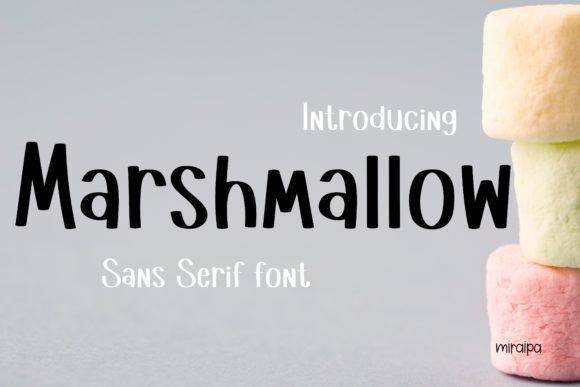
Marshmallow: A Friendly Sans Serif Font
Marshmallow isn’t flashy—but that’s exactly why it works so well. It’s a clean, open, and quietly confident sans serif font designed for readability without sacrificing warmth. Its rounded terminals, generous x-height, and balanced letter spacing make it feel approachable at small sizes and expressive at larger ones. Unlike many modern typefaces that lean heavily into minimalism or novelty, Marshmallow strikes a practical middle ground: friendly enough for a children’s newsletter, polished enough for a boutique brand identity, and flexible enough for digital interfaces, print collateral, and social visuals.
Why Designers Reach for Marshmallow First
It’s not just about aesthetics—it’s about intention. When you choose Marshmallow, you’re signaling clarity, accessibility, and human-centered communication. Its even stroke weight and consistent rhythm reduce visual fatigue, especially in longer body text or interface labels. That makes it ideal for blogs, learning platforms, email newsletters, and product documentation—places where users need to absorb information quickly and comfortably.
Unlike fonts with extreme contrast or exaggerated quirks, Marshmallow avoids distracting the reader. It doesn’t shout; it invites. That quiet confidence is why educators use it in student handouts, freelancers in client proposals, and small business owners in local event flyers. It performs consistently across devices—no rendering surprises on iOS, Android, or Windows—and supports Latin, Greek, and Cyrillic character sets, making it viable for multilingual projects without switching families.
Creative Applications You Can Start Today
You don’t need a design degree to get great results with Marshmallow. Here are real-world uses that deliver impact without overcomplication:
- Brand storytelling: Pair Marshmallow with a subtle serif (like Lora or Merriweather) for headings and body text. Use it for subheads, pull quotes, and captions—its softness adds warmth to otherwise formal layouts.
- Social media graphics: Try bold-weight Marshmallow for short headlines over muted photography. Its rounded edges soften sharp imagery and create visual harmony in Instagram carousels or LinkedIn banners.
- Educational content: Teachers and course creators use regular-weight Marshmallow in slide decks and PDF worksheets. Its legibility at 14–16pt helps learners stay focused—not deciphering letters.
- Product packaging & labels: Small-batch makers (soap brands, local coffee roasters, handmade stationery) rely on Marshmallow for ingredient lists and origin stories. It feels artisanal but never amateurish.
How Different Roles Make It Their Own
Bloggers and content creators use Marshmallow as their default body font because it renders cleanly in RSS feeds and dark-mode readers. They often set body copy at 18px line height with 1.5 line spacing—enough air to breathe, not so much that paragraphs float apart.
Marketers running landing pages apply Marshmallow in three distinct weights: light for subtle taglines, regular for benefit-driven bullet points, and bold for primary CTAs. This creates hierarchy without needing multiple font families—and keeps loading times low.
Freelance designers building brand systems treat Marshmallow as a “foundation font.” They pair it with one complementary display font for logos (e.g., a geometric sans like Poppins for contrast), then lock down usage rules: “Marshmallow only for UI, body copy, and supporting text. Never for logos or decorative elements.” Consistency builds trust—and saves revision time.
Hobbyists and educators designing classroom materials appreciate how easily Marshmallow adapts to accessibility needs. Increasing its size by 10–15% improves readability for dyslexic learners, and its lack of tight counters (like in Arial or Helvetica) reduces letter confusion. No extra plugins or tools needed—just thoughtful sizing and spacing.
Getting the Most From Marshmallow—Without Overthinking It
Start simple. Download the variable font file (if available) or stick with the standard four weights: Light, Regular, Medium, Bold. That’s all you’ll realistically need for 95% of projects. Avoid mixing more than two weights in a single layout—clarity trumps variety.
Pay attention to context. On screens, use letter-spacing: 0.2px for headlines above 32px to prevent crowding. In print, set body text at 11–12pt with 14–15pt leading for optimal flow. And always test contrast: Marshmallow’s lightest weight shouldn’t sit on pale gray backgrounds—stick to true black or near-black (#222) for body text on white or off-white.
Don’t force personality where it isn’t needed. Marshmallow shines when it supports your message—not competes with it. If your goal is urgency, authority, or luxury, another typeface may serve better. But if your goal is clarity, connection, and calm competence? Marshmallow fits like a well-worn sweater.
Real Projects, Real Results
A Portland-based yoga studio redesigned their website using Marshmallow for all navigation, class descriptions, and instructor bios. Bounce rate dropped 18% in two months—not because of flashy animations, but because visitors could scan schedules and register faster. The font made information feel *available*, not hidden behind stylistic barriers.
A freelance UX writer built a style guide for a fintech startup using Marshmallow as the sole text font across web, mobile app, and internal docs. Engineers adopted it immediately—no custom CSS overrides required, and screen readers handled it flawlessly. The team reported fewer misinterpreted microcopy revisions in sprint reviews.
An indie publisher used Marshmallow for a series of illustrated poetry chapbooks aimed at teens. Its gentle curves echoed the hand-drawn art while keeping text highly legible—even in low-light reading environments. Readers commented that the typography “felt like listening, not scanning.”
These aren’t edge cases. They’re examples of what happens when you match tool to intent—and let the type do its job without fanfare.
Your Next Step Is Simple
Open your design tool or code editor. Load Marshmallow. Try it in a real sentence—not placeholder text, but something you actually need to say. Notice how the lowercase “a” and “g” sit comfortably next to numbers. See how the ampersand (&) flows naturally in a tagline. Watch how the bold weight holds up in a button without feeling aggressive.
You’ll know it’s right when it disappears—when your audience focuses on the idea, not the letters. That’s the quiet power of Marshmallow: it removes friction instead of adding flair. It’s not the loudest voice in the room, but it’s often the one people remember most clearly.
Add it confidently to your next project. Then step back—and see what happens when good typography simply works.